Shoes
How Shoe Lacing and Tongue Construction Actually Work
Gusseted tongues, tongue loops, eyelet hardware, and heel-lock lacing decide how a shoe holds the foot. What each construction buys a high instep.
By Claire Donovan · Published Oct 11, 2026 · Updated Oct 12, 2026
The short version
Gusseted tongues, tongue loops, eyelet hardware, and heel-lock lacing decide how a shoe holds the foot. What each construction buys a high instep.
Every label term in this guide is explained in what the symbols actually mean .
The laces get the attention, but two quieter components decide how a shoe holds the foot: the tongue and the hardware the laces pass through. Both are visible before you buy, and both explain fit complaints that get blamed on sizing.
How the tongue is attached
Tongue construction runs along a spectrum of how much the flap is tied into the upper:
| Construction | How it is built | What it trades |
|---|---|---|
| Free-floating | Base only, free flap | Most adaptability, most slide |
| Center loop | Small top tab the laces pass through | Centered tongue, minimal bulk |
| Side gussets | Wings stitch the tongue to the upper | No slide, sealed against grit |
| Bootie | Merged into a stretch inner sleeve | Sock-like hold, least adjustability |
A gusseted tongue is the trail-runner standard: the wings anchor it and keep dust and gravel out. The trade-off is real for a high instep — a full gusset wraps the whole top of the foot and cut tight it binds where pressure builds.
The center loop is the cheapest fix for the most common annoyance. A drifting tongue concentrates lace pressure on one edge and rubs; running the laces through the loop pins it centered without the gusset’s full wrap.
Eyelets and where pressure lands
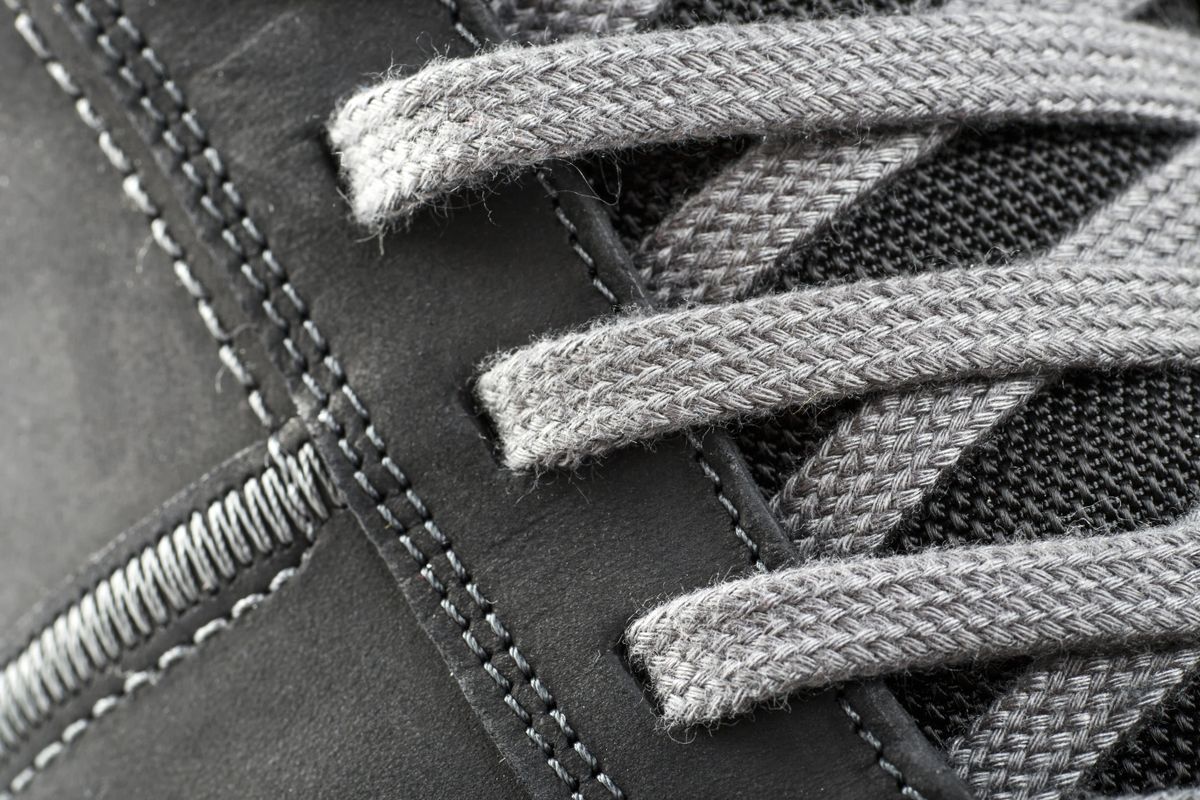
Hardware is not decoration. Eyelets set into a reinforced lace stay spread lace tension across the panel; a bare punched hole in soft fabric deforms under load and the lace saws the same few threads. D-rings on hiking boots let thick laces run with less friction; speed hooks trade fine tension control for fast on-and-off, which is why hooked boots still finish with a tie.
Eyelet count and placement set how much instep the lacing can hold. Running shoes typically add one extra eyelet above the main pattern — the heel-lock point — and leave the top pair unlaced from the factory. That pair is not a spare.
Lacing patterns as fit tools
The pattern is the adjustment layer between a fixed last and a variable foot. Four patterns cover most fit problems. Heel lock, the runner’s loop, clamps the collar against the heel. Window lacing skips the eyelets over a sore spot on top of the foot. Ladder, or parallel, lacing removes the diagonal cross over the metatarsals for a wide midfoot. Skipping the first eyelet pair shifts crossing away from the toes.
Heel lock lacing converts the laces’ sideways pull into downward pressure at the ankle: each end goes up through the top eyelet on its own side, the ends cross through the opposite loops, and pulling downward cinches the collar. Research on lacing patterns published in the late 2000s found the seven-eyelet version produced the lowest peak heel pressures tested. A skip-sixth variant — fifth eyelet straight to the seventh — trades a little heel security for relief across the instep.
Choosing for a high instep
The checklist is short. Look for a padded tongue with a center loop or partial rather than full gussets, so the top of the foot is cushioned but not wrapped, and a lace stay high enough to give the instep somewhere to be. Then lace with a window over the pressure point and confirm the fit before adding any heel lock. If a shoe binds across the instep no matter the lacing, the last is too shallow — no pattern solves that, and the same spec-first logic from the white leather sneakers guide applies to the rest of the upper. For how the sole connects to it all, sole attachment methods decide whether the platform survives the season.
Claire Donovan
Spent eight years in womenswear buying before moving to editorial research. Reads care labels for fun and returns nothing without a wear log. How we rate.
More in Shoes
FAQ
- Why does my shoe tongue slide to one side?
- A free-floating tongue is sewn only at its base, so it shifts under the sideways pull of the laces. Two constructions fix it: side gussets — fabric wings stitching the tongue to the upper so it cannot drift — or a tongue loop, the small fabric tab near the top that the laces pass through to pin the tongue centered. If a shoe has neither and the slide bothers you, lacing through whatever tab exists usually holds it.
- What lacing pattern helps a high instep?
- Window lacing. Skip the pair of eyelets that sits over the pressure point and lace vertically up each side instead of crossing over the top, which opens a gap — the window — exactly where the instep presses. It keeps tension everywhere else while relieving the one spot that hurts. If the shoe still binds, the upper itself is too shallow for your foot, and no lacing pattern fully fixes a last mismatch.
- What is heel lock lacing and when should I use it?
- Heel lock lacing, also called the runner's loop, uses the extra eyelet at the top of the panel: each lace end goes through the top eyelet on its own side to form a loop, then the ends cross through the opposite loops and pull down, clamping the collar against the heel before you tie off. Use it when the heel lifts or the foot slides forward, which causes blisters and black toenails. Published biomechanics research on lacing patterns has associated it with lower peak pressure at the heel than standard crossing.