Clothing
White Shirt Fabric: Reading GSM Before It Shows Through
Why white shirts go see-through, what grams per square meter actually predicts, and why thread count tells you less than the weight number a listing omits.
By Claire Donovan · Published Sep 19, 2026 · Updated Sep 19, 2026
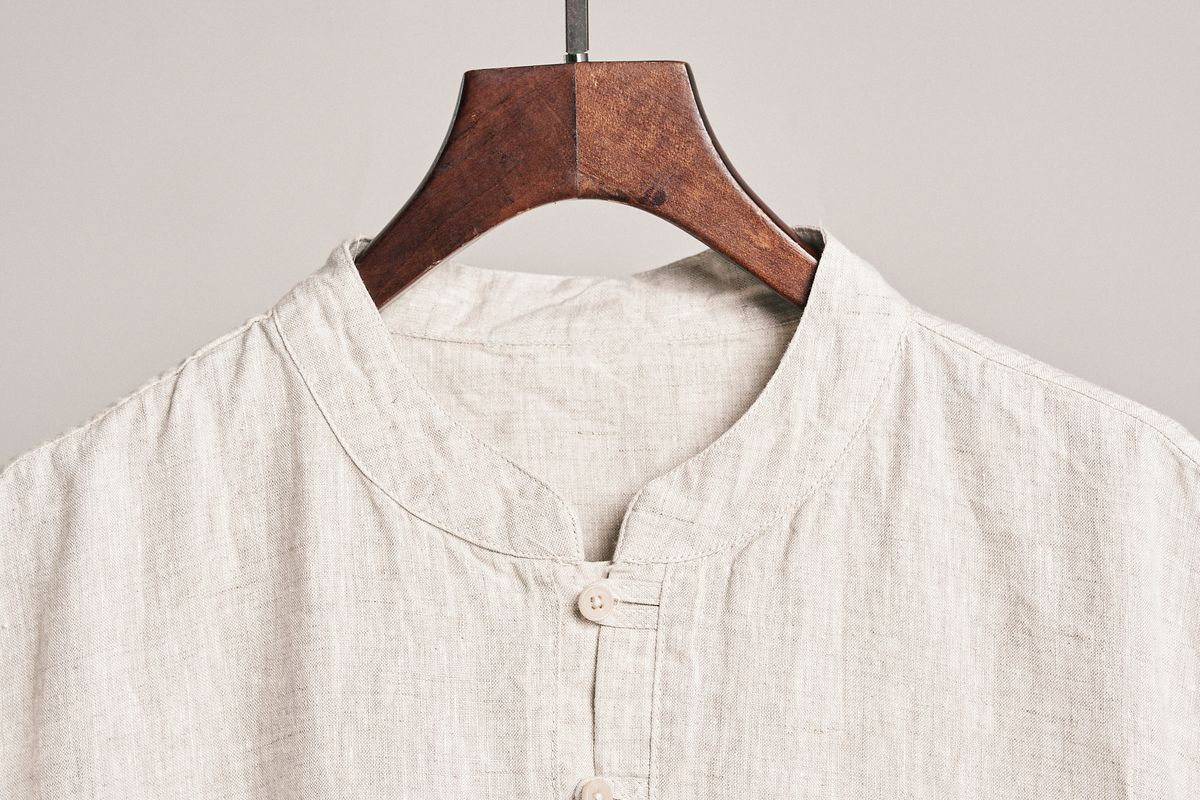
A white shirt is the fastest way to learn what your laundry scale already knows: fabric weight is the spec that decides whether the shirt reads crisp or translucent. Listings rarely print it. Instead they advertise thread counts and weave names, neither of which answers the question you actually have — will this show through under office lighting?
GSM: the number listings should print
Fabric weight is measured in grams per square meter, and shirting lives in a narrow band of it. Factory reference tables put cotton poplin and broadcloth at roughly 100 to 140 gsm, oxford cloth a step heavier at around 130 to 180, and linen shirting near 110 to 140. Production-side guidance is blunt about the lower edge: one shirt manufacturer’s sourcing notes state that white poplin under about 115 gsm is nearly always see-through under bright retail lighting, and recommend moving up to a 120 gsm twill when opacity matters. That single number predicts more about a white shirt’s behavior than any adjective on the product page, which is why its absence from most listings is worth noticing.
Why white shows more than any other color
Transparency is a physics problem before it is a quality problem. Light passes through any woven fabric to some degree; what varies is how visible the passage is. A white fabric face reflects nearly all wavelengths, so the light coming through from behind — and the shadow of a hand, a tag, skin — contrasts sharply against it. The same fabric in navy hides the same translucency, because what bleeds through is close in tone to the fabric face. This is why the identical poplin body can look opaque in black and exposing in white, and why white shirts carry the burden of the weight spec that other colors get to ignore.
The thread count trap
Thread count — the sum of warp and weft yarns per square inch — sounds like a density measure, but it can be inflated without adding fabric. Yarns spun from multiple plies let a manufacturer double the count on paper while weaving the same or lighter cloth, a practice long documented in bed linen and carried into shirting marketing. Two shirts can print the same impressive number while differing in weight by 30 gsm, and the heavier one is the opaque one. When a listing gives you a thread count and no gsm, it is answering the question you did not ask.
A transparency test before you buy
In person, the test takes ten seconds: hold the fabric up to a light source and press a hand flat against the inside. Fingers blurred behind the cloth is normal for a dress shirt; fingers clearly outlined means the weight is too light for a white you plan to wear to work. Online, read the listing for gsm first, weave second — a 130 gsm oxford forgives more than a 105 gsm broadcloth — and treat “luxury lightweight” phrasing as a warning rather than a feature, since the words most often appear where the number does not. And note that a white shirt reads most translucent over bare skin; the undershirt you plan to wear changes the answer.
If the plan is one white shirt doing several jobs inside a small wardrobe, the capsule wardrobe, audited works through the counting, and how to read a tote bag listing applies the same read-the-spec-first habit to another category.
FAQ
- What GSM should a white dress shirt be to avoid see-through?
- White poplin in the 100 to 140 gsm range is standard for dress shirts, and production guidance from shirt manufacturers puts the see-through threshold under bright light at roughly 115 gsm for white. Above about 120 gsm, a tightly woven white poplin rarely shows more than a shadow at the pocket.
- Is a higher thread count shirt always less transparent?
- No. Thread count can be inflated by counting plies, and a tightly woven high-count fabric in a very light weight can still pass light easily. Fabric weight in gsm is the more honest predictor of opacity, because opacity comes from how much fiber sits between you and the light.
- Does fabric color affect transparency?
- Strongly. A dark navy shirt hides its own translucency because what shows through blends with the fabric face. White does the opposite — light passes through and bounces back off whatever is behind it, so skin tone and underlayers read clearly through a fabric that would look opaque in navy.
Claire Donovan
Spent eight years in womenswear buying before moving to editorial research. Reads care labels for fun and returns nothing without a wear log. How we research.