Guides
Secondhand Clothing: A Ten-Point Inspection Before You Pay
Thrift and resale finds need a different checklist than new garments: stress points, odor mapping, hardware, label law, and the flaws worth paying for.
By Claire Donovan · Published Nov 9, 2026 · Updated Nov 9, 2026
The short version
Thrift and resale finds need a different checklist than new garments: stress points, odor mapping, hardware, label law, and the flaws worth paying for.
Every label term in this guide is explained in what the symbols actually mean .
Buying secondhand changes the inspection problem. A new garment’s risks are latent — shrinkage, pilling, seam failure that has not happened yet. A used garment’s risks are already on the garment, visible if you look in the right order, and the price usually assumes you will not. Resale racks are also where the interesting fabrics live: older construction, heavier cloth, construction choices that went out of production. Ten checks, run in the same sequence every time, separate the finds from the regrets.
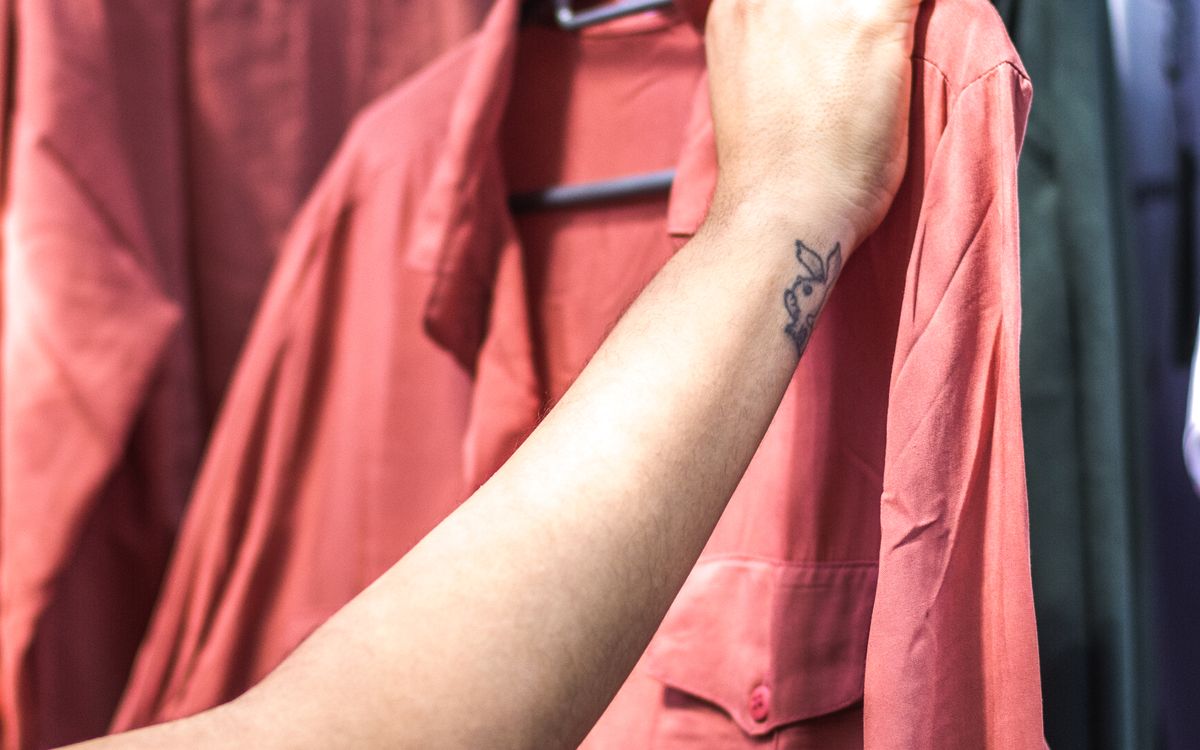
Light on the fabric, garment on a hanger — the position every inspection starts from.
1. Hold it to the light first
Stretch the fabric gently between your hand and a light source. Thinned areas, pinholes, and repaired spots show as bright points long before they fail outright. This one gesture covers the most expensive class of secondhand flaws: structural fabric damage on wool and silk, which cannot be washed back. Pay particular attention to elbows, seat, and the fold lines of anything that spent years in a drawer.
2. Map the stress points
Garments fail where movement concentrates. Turn sleeves inside out to see the underarm seam — the single highest-stress join in any shirt or jacket — and flex it between your thumbs to check the stitching still holds tension. Check the crotch seams on trousers, the corner anchors of pockets, and the points where straps meet the body of a dress. A slightly pulled thread is history; a seam under visible strain is a countdown.
3. Read the seams as a manufacturing record
Seam quality is the secondhand market’s version of a spec sheet. Even, tight stitching, generous seam allowances, and flat or French seams on the right garments tell you the piece was built to a standard that survived its first owner. The seam construction guide names the types; in the rack, the practical version is a thirty-second comparison of stitch density against anything else in your closet.
4. Smell in zones, not in general
Odor carries information that sight misses. Mildew lives in folds and linings; smoke settles into the inner collar; sweat damage announces itself at the underarm before it is visible as fabric degradation. A garment that smells strongly of perfume or storage may simply need an evening of airing — or it may be masking a set odor that professional cleaning only partially touches. Sniff the underarms, the collar, and the lining hem specifically.
5. Check the hardware with ten cycles in mind
Work every zipper end to end; a zipper that catches once will catch habitually, and a split-slider repair costs more than the garment often justifies. Flex buttons for looseness at their shanks — the same sew-through versus shank distinction that matters on new garments matters more used, because loose threads there are already mid-failure. Buckles, snaps, and hook-and-bar closures at the waistband all get the same treatment. Hardware is honest; fabric wears gracefully, sliders jam.
6. Find the fiber and care labels, then imagine the next wash
A missing tag is common secondhand and changes the math: without a fiber content claim you are guessing at shrinkage and iron tolerance. When the tags survive, cross-read them — the care symbols guide turns the pictograms into a wash plan, and the Care Labeling Rule explainer covers what sellers are required to keep on the garment. A great-looking garment whose care demands exceed your actual laundry habits is a wrong purchase at any price.
7. Judge the fit against a garment that already fits
Resale sizing is a trap twice over. Older garments were cut to different block sizes, so a vintage tag reads differently from a modern one, and vanity sizing has quietly moved the modern numbers anyway. Bring a reference garment you own and know fits, and lay the candidate against it at the shoulders and pit-to-pit width. Two minutes of comparison beats any number printed on the tag.
8. Weigh alteration potential before buying the wrong size
A garment that fits the shoulders and the rise can usually be altered at a fraction of its quality value; one that fits nowhere cannot. The rule of thumb among tailors — let out or take in at the seams where there is allowance, leave shoulders and re-cutting alone — holds especially at resale prices, where a thirty-dollar alteration on a well-made jacket is proportion that a new garment at three times the price would struggle to match.
9. Authenticate the claims that can be checked
Labels claiming wool content fall under labeling law, and the Textile Act explainer covers what the percentages must mean. On branded goods, check the inner label printing quality, the stitching of any logo patch, and — on higher-value resale — that the hardware engraving matches the brand’s known details. Counterfeits reach thrift racks through estate clearouts, and most are caught by exactly these three surfaces rather than by price intuition.
10. Price the flaws, then decide
The last step is arithmetic, not sentiment. Stains on washable cloth, a missing button, a hem to re-stitch: all bargaining points, costed at the repair you would actually do. Set odors, moth grazing on wool, lining sweat damage, sun-faded shoulders, and a jammed slider on a non-replaceable zipper: walk-away items, because the repair exceeds what the garment can carry at resale prices. The garment that survives all ten checks with only priced flaws is the one worth carrying to the register.
None of this takes longer than three minutes per garment, which is why it works as a habit rather than an occasional discipline. Run the sequence the same way every time — light, stress, seams, odor, hardware, labels, fit, alteration, authenticity, arithmetic — and the rack stops being a gamble and becomes an inventory with known defects, priced in.
Claire Donovan
Spent eight years in womenswear buying before moving to editorial research. Reads care labels for fun and returns nothing without a wear log. How we rate.
More in Guides
FAQ
- Can a care label be missing on a used garment?
- Yes, and it happens constantly — tags are cut out, wear off, or the garment predates stricter enforcement. The Care Labeling Rule applies at the point of sale, so secondhand retailers still benefit from keeping labels intact, but a missing tag shifts the fabric-identification work onto you: check the fiber content tag on the inner seam and treat any care instructions you cannot find as unknown.
- What single flaw should stop a purchase immediately?
- Any sign of moth damage on wool — pinpoint holes, irregular grazing lines, or weak spots that tear under gentle tension. Moth grazes are rarely isolated, and repairing scattered damage across a knit or coating costs more attention than the garment is usually worth.
- Is a small stain a dealbreaker?
- Depends where and what. A set stain under the arm of a lined jacket usually signals sweat damage to the lining, which is hard to reverse; a small mark near the hem on a washable cotton garment is often a bargaining point rather than a flaw. Map the stain, identify the fiber, and decide with the care method in hand.